Friday, May 28, 2010

Briggs Cunningham: Tale Of An American Sportsman

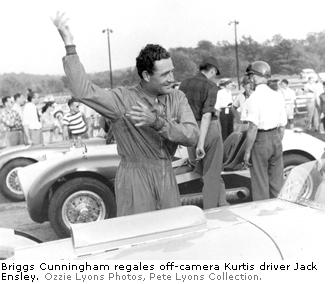
A few years ago I had the honor of designing and producing the Briggs Cunningham biographical website. Cunningham was a fascinating man whose story I believe any muscle car fan or hot rodder will appreciate.


Thursday, May 13, 2010

An Impromtu Visit With The Ultimate Car Guy

Richmond Street Rodders welcomed Jay Leno at Vancouver Int'l Airport, Saturday May 8 on his way to a private speaking engagement. A great time was had by all.


I received this message last Thursday, May 5 from my friend Gord James, president of the Richmond Street Rodders in Richmond, BC, home of Vancouver International Airport:
Jay Leno is arriving in Vancouver this Saturday for a private function. Nigel Matthews mentioned that if we parked our cars along the grass beside the road by the Helijet terminal (Inglis Dr., across from McDonalds), he might stop and say hello. We should be there by 6:00.
 
Gord
Sure enough, Jay stopped by on his way into Vancouver, and we have a few photos of his visit from the good folks in the RSR.


Big kudos go to Nigel Matthews for making it happen.

Tuesday, May 11, 2010

Le Mans and Nurburgring Winner 1959 Ferrari 250 GT LWB Tour de France At Mecum Monterey 2010

Mecum Auctions has consigned 1959 Ferrari 250 GT LWB Tour de France s/n 1321 to headline its second annual Mecum at Monterey Auction, August 13-14.

Le Mans and Nurburgring Winner
The Ferrari finished 3rd overall and 1st in class at Le Mans in 1959, under the Equipe Nationale Belge banner, and piloted by Jean Blaton and Leon Dernier. Earlier in the year, s/n 1321 finished 1st in class at the Nürburgring 1000Km. The car comes to auction following a long period in private hands.

Watch this blog for more information on this historically significant collector Ferrari.

Wednesday, May 5, 2010

1962 Plymouth Savoy Max Wedge 413

Part of the 1962 Chrysler B-body’s universal appeal to period racers is that its somewhat stodgy styling hid a technologically advanced drivetrain that made it capable of trailering everything it met. In other words, the B-Body 413 Max Wedge was the perfect sleeper: even after everyone woke up to it, it was still unbeatable. In his 2004 book Tales from The Drag Strip, Don Garlits describes driving a 413 Max Wedge with his wife Pat on the highway to Texas in 1962: “With a 3.31 gear, [we’re] leaving rubber at 120 mph and we just drove away from that Ford! I bet that guy talks about that to this day to his grandchildren!”


This exemplary '62 Wedge is consigned to Dana Mecum's Original Spring Classic Auction for sale on Saturday May 22.

Thursday, April 29, 2010

1970 Camaro RS/SS396 4-Speed

My first Camaro was a 1972 Z28 RS. LT1 engine, M22 4-speed, 3.73 Posi. GREAT car, one of the best Chevrolet ever made to that time. If not for a twist of fate, I would have bought a neighbor's primo SS396 Rally Sport Coupe, so you can imagine how much I really, really like this loaded Cortez Silver RS/SS.


Saturday, April 17, 2010

This Month In Sports Car Market


Few cars shock the senses quite like a well-executed Pro Street machine, and this gleaming Black Ferrari 250 GTE may be the most shocking Pro Street car we have ever seen. This is the world’s only Pro Street version of the Prancing Horse. Professionally built and based on a real Ferrari 250 GTE Berlinetta coupe, it is filled with all the ingredients that separate NHRA’s top street class from the rest, from the free-breathing hood scoop feeding a pro-built 565 CI Chevrolet big block, to the huge street slicks tucked up inside the tubbed rear, to the show-quality, fully-caged Red interior. $150,000 was invested in the car, which is both street legal and NHRA certified to 8.50-second elapsed times.


In recent years the term “Survivor” has entered the collector car lexicon as a way of describing a well-preserved, original, unrestored vehicle. “Survivor” is not, however, just a generic term that caught on organically; it is in fact a trademark registered by Bloomington Gold founder David Burroughs, and in 1989, this Marlboro Maroon 1967 427 convertible became Burroughs' prototype for establishing standards for the Bloomington Gold Survivor Award.

For years, Burroughs had encouraged the owners of excellent original Corvettes to forego their restoration and preserve their originality, even searching out and buying this unrestored 1967 Corvette convertible to demonstrate his commitment to that ideal. In 1989, Burroughs registered the word “Survivor” with the U.S. Patent and Trademark Office and created the Bloomington Gold Survivor Award for the specific purpose of rewarding the preservation of original unrestored Corvettes that are of a quality to serve as educational benchmarks for other restorers. Since then, over 1,000 original Corvettes have been preserved for that very purpose, and Bloomington Gold has expanded the Survivor certification to include other marques.

Original and unrestored, the "Survivor Platform Car" is finished in its factory-applied Marlboro Maroon paint with a Black interior. Under the Stinger hood sits the classic Tri Power 427 with a Muncie 4-speed. The 435 hp V-8 features a high lift, long duration camshaft and large port cast iron heads, on top of which is the famous triple 2-barrel Holley carb setup on an aluminum intake manifold. Optional equipment includes side-mounted exhaust, finned aluminum bolt-on wheels and the car’s trademark hard top.

Adding to the car’s standing is the fact that in 2003 it also won the NCRS Chevrolet Bowtie Award, making it one of a very few to have reached the highest unrestored Corvette status. In 2006, it was selected for the Bloomington Gold Special Collection.

As Miles Collier once observed, a car can only be original once; together David Burroughs and his famous "old 435" demonstrated the importance of that sentiment to future generations of Corvette owners and enthusiasts.


Happy Birthday, Mustang

The First Mustang Produced - photographed by DougW of RemarkableCars.com at The Henry Ford in Dearborn, MI. This is Mustang Serial #1, produced in 1964, titled as a 1964 1/2 Mustang due to the fact that the first Mustangs did not come out until the middle of the year.


As Lee Iacocca's assistant general manager and chief engineer, Donald N. Frey was the head engineer for the Mustang project — supervising the overall development of the Mustang in a record 18 months - while Iacocca himself championed the project as Ford Division general manager. The Mustang prototype was a two-seat, mid-mounted engine roadster. This vehicle employed a Taurus (Ford Germany) V4 engine and was very similar in appearance to the much later Pontiac Fiero. It was claimed that the decision to abandon the 2 seat design was in part due to the low sales experienced with the 2 seat 1955 T-Bird. To broaden market appeal it was later remodeled as a four-seat car styled under the direction of Project Design Chief Joe Oros and his team of L. David Ash, Gale Halderman, and John Foster - in Ford's Lincoln-Mercury Division design studios, which produced the winning design in an intramural design contest instigated by Iacocca.

Having set the design standards for the Mustang, Oros said:
I told the team that I wanted the car to appeal to women, but I wanted men to desire it, too. I wanted a Ferrari-like front end, the motif centered on the front – something heavy-looking like a Maserati, but, please, not a trident – and I wanted air intakes on the side to cool the rear brakes. I said it should be as sporty as possible and look like it was related to European design.
I then called a meeting with all the Ford studio designers. We talked about the sporty car for most of that afternoon, setting parameters for what it should look like -- and what it should not look like -- by making lists on a large pad, a technique I adapted from the management seminar. We taped the lists up all around the studio to keep ourselves on track. We also had photographs of all the previous sporty cars that had been done in the Corporate Advanced studio as a guide to themes or ideas that were tired or not acceptable to management.

Within a week we had hammered out a new design. We cut templates and fitted them to the clay model that had been started. We cut right into it, adding or deleting clay to accommodate our new theme, so it wasn't like starting all over. But we knew Lincoln-Mercury would have two models. And Advanced would have five, some they had previously shown and modified, plus a couple extras. But we would only have one model because Ford studio had a production schedule for a good many facelifts and other projects. We couldn't afford the manpower, but we made up for lost time by working around the clock so our model would be ready for the management review.